
'The real story of 2025 is that India officially stopped being a 'market of the future' and started acting as the world's primary economic engine.'
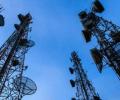
It aims to attract $100 billion investment and create 4 million jobs in the sector by 2022.

Prime Minister Manmohan Singh on Thursday said a strong domestic manufacturing base in electronics and telecommunications will mitigate burden of growing imports for the sector.

India's market regulator is moving ahead to include real estate investment trusts (Reits) in benchmark indices in a phased manner, Sebi chief Tuhin Kanta Pandey said, while asserting that the regulator was working to strengthen the link between infrastructure building and the markets.

The Supreme Court recently quashed a rule that mandated telecom operators to compensate consumers.

Officials said the bill has provided a clear legal basis for spectrum allocation, which till now was allocated or auctioned by the government based on the interpretation of various laws and judgements.

Telecom industry in India is in a mess and it is a result of thinking that more the competition better it is, Vodafone India CEO & Managing Director Marten Pieters said on Thursday.
NTP 2012, approved in May, aims to abolish roaming charges and allow mobile phone subscribers to use same number across country without having to pay extra charges for services once they are outside their telecom circle.
NTP 2012, approved in May, aims to abolish roaming charges and allow mobile phone subscribers to use same number across country without having to pay extra charges for services once they are outside their telecom circle.
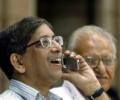
it will allow users to retain their numbers even if they move from one state to another.

The Department of Telecommunications (DoT) expects to finalise the norms for mergers and acquisitions and spectrum sharing by the end of June. It also plans to approve the National Telecom Policy (NTP), 2012, by the end of July.

Earlier, during the day, Telecom Minister Kapil Sibal met various operators to discuss the national broadband policy.

The regulator has also agreed to the one-nation, one-licence proposal, which will make roaming free across the country. But it wants to decide the modalities of the issue.

Over 25 crore workers across India are set to strike against new labour codes and privatisation, potentially disrupting banking, postal, and other essential services.

The second largest telecom operator said auction would avoid possible legal disputes and pave the way for licence extensions.
The government believes firms which are subject to China's laws could be forced to hand over information to Beijing's security services.

Simplifying GST rates, removing exemptions, easing disputes, and speeding up refunds can boost investment in India and offer the best reply to Trump's tariffs, observes V S Krishnan, former member, Central Board of Indirect Taxes and Customs.

India needs to be technologically and militarily prepared to defend itself from both Pakistan and China, alerts Ramesh Menon.
Rajasthan, Assam, Himachal Pradesh and Tripura among states that will set up an institute each.
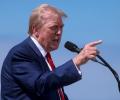
Essential and strategic items such as pharmaceuticals, semiconductors, copper, and energy products like oil, gas, coal and LNG are exempted from the 27 per cent import duty announced by the US on Wednesday, according to think tank GTRI.
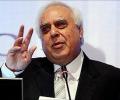
Amid increasing number of cyber attacks and snooping, the government on Tuesday announced the national cyber security policy that aims to protect information and build capabilities to prevent such attacks.

'Tinkering will not do. Merely staggering spectrum dues comes nowhere near solving the problem,' cautions Rahul Khullar.

While India has become the largest data generating nation, and hosts more than 152 data centres, it is fed by only 18 undersea cables.
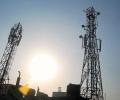
Telecom equipment from China may face fresh curbs after the Cabinet on Wednesday cleared a proposal to secure telecom infrastructure by designating a "trusted source" for the purchase of equipment by service providers. Briefing reporters after the meeting of the Cabinet Committee on Security headed by Prime Minister Narendra Modi, Law, Telecom and IT Minister Ravi Shankar Prasad said a National Security Directive on Telecommunication Sector has been framed keeping in mind the national security.

Telecom regulator Trai on Monday announced reduction in the national mobile phone roaming charges, but said there will be no free national roaming as of now.
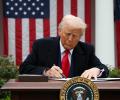
On India, the chart showed that the country charged 52 per cent tariffs on the US "including currency manipulation and trade barriers," and America will now charge India "discounted reciprocal tariffs" of 26 per cent.

The government is expected to outline a policy framework for artificial intelligence (AI) at the annual India Mobile Congress (IMC) 2024, beginning Tuesday, officials said. Apart from industry participation, the four-day event will feature booths from over 15 ministries showcasing how AI is being integrated into their departments.

India's policy for agriculture trade must move commodity-by-commodity to gain maximum benefits as US President Donald Trump's 26 per cent tariff on exports from the country take effect, said agriculture economist Ashok Gulati in a recent policy paper.

Here is a list of Q & As to explain these issues and implications of the US move.
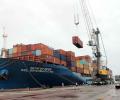
Industry associations and companies in the United States, including the US Chamber of Commerce, Coalition of Services Industries and the iconic bike company Harley Davidson have called on the Donald Trump dispensation to push India to reduce tariffs, non-tariffs, and regulatory barriers to boost American exports.
Sibal, who is also looking after the telecom ministry, claimed that change of telecom policy by the then communication minister Pramod Mahajan in 1999 from the auction model to the revenue share model eventually led to the first come first serve controversy of 2001.

DeepSeek is a case in point on how economic interdependence between nations are utilised for geopolitical ambitions and global domination efforts, observes China expert Srikanth Kondapalli.

Indian telecom sector has registered a phenomenal growth and has become second largest telephone network in the world after China.

Modelled loosely around the National Highway System of the US, he in 2001 launched the Golden Quadrilateral and the North-South & East-West Corridor projects to build 4/6 lane highways between four top metropolitan cities of Delhi, Mumbai, Chennai and Kolkata as well as from Srinagar to Kanyakumari and Porbandar to Silchar.
